
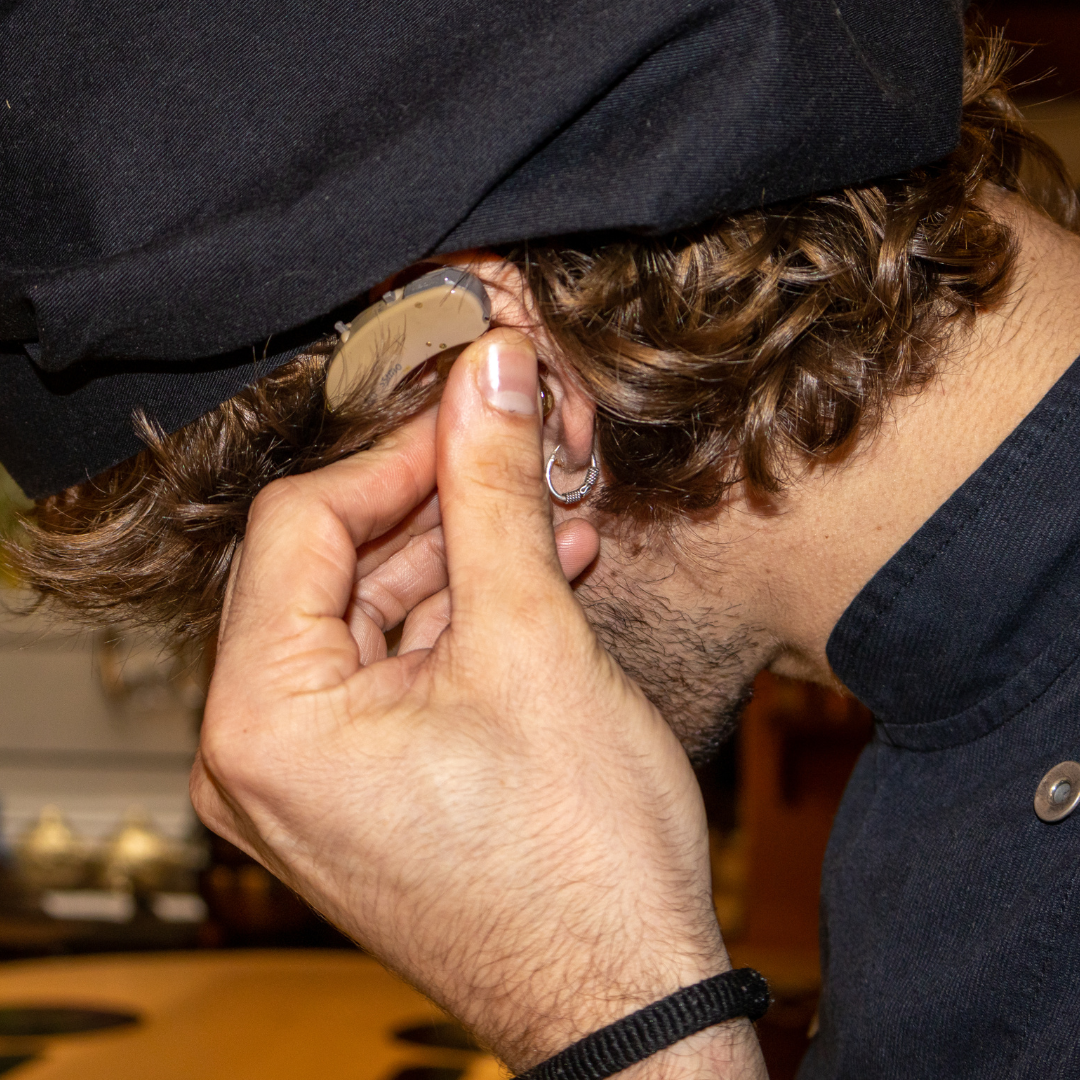
Following dinner conversations becomes challenging when high ambient noise interferes with your focus and hearing. Our clinical team can evaluate hearing across quiet settings and background-noise environments to pinpoint specific auditory challenges. When we isolate the root mechanism behind your difficult hearing, we guide you toward customized communication solutions.
Why Do I Hear Well in Quiet but Struggle in Restaurants?
Low-noise environments yield an advantageous signal-to-noise ratio where primary speech remains significantly louder than background sound. Restaurants create the opposite situation. Cross-talk, ambient music, dishware noise, and harsh acoustic reverberation interfere with speech clarity, forcing your brain to labor to extract the target voice.
These auditory struggles commonly accompany untreated high-frequency hearing loss, central processing delays, or presbycusis. Poor visual illumination, mental fatigue, physical distance from the speaker, and divided focus exacerbate speech-recognition problems. It is common to display normal baseline audibility on conventional hearing tests while failing comprehensive speech-in-noise testing. Consistent difficulty following restaurant conversation warrants clinical investigation even when everyday hearing seems largely unaffected.
Diagnostic Protocols for High-Frequency Hearing Loss
We begin by reviewing your history of communication difficulties, prior noise exposures, ringing or tinnitus, pharmaceuticals, and unilateral symptoms.
Through pure-tone audiometry, we determine your faintest auditory perception across low to high pitches utilizing both air and bone conduction testing. High-frequency hearing loss commonly presents on the audiogram as a characteristic precipitous drop in the higher frequency ranges. Additional testing may include tympanometry to assess middle-ear function and word-recognition testing to measure speech understanding.
Because testing in a silent booth does not mirror real-life restaurant environments, speech-in-noise testing supplies vital diagnostic clarity. It measures how well you recognize words or sentences as competing sounds become louder. Together, these audiological findings indicate whether the issue involves sound audibility, speech intelligibility, noise-processing dysfunction, or multiple compounding factors.
How Do Auditory Processing Disorders Affect Hearing in Adults?
A diagnosed auditory processing disorder affects how the brain’s auditory cortex analyzes, organizes, and interprets sound. Even when the ears detect individual frequencies accurately, the central auditory system may falter at sorting overlapping voices, distinguishing close speech sounds, or processing fast-paced dialogue. We prioritize assessing peripheral auditory acuity before recommending an in-depth central auditory-processing assessment or external medical referrals.
What Strategies Can Improve Hearing in Noisy Environments?
Small changes can improve the signal reaching your ears and provide clearer visual cues. Prior to dining, choose venues known for lower noise levels or schedule meals during quieter dining hours. Establishments designed with high-walled booths, acoustic wall treatments, heavy fabrics, and carpeting reduce reverberation far better than modern industrial spaces with bare surfaces.
Practical seating strategies in the dining room:
- Ask host staff for a quiet table distanced from kitchen traffic, bar noise, audio speakers, and loud group tables.
- Position your chair against a perimeter wall to diminish competing auditory chatter behind your head.
- Face your conversation partners in good lighting.
- Keep conversational proximity as close as comfortably feasible to preserve acoustic signal strength.
- Direct your better-performing ear toward the companion you most need to understand.
- Request that companions rephrase misunderstandings using different words rather than repeating the same sentence.
- Confirm important details rather than pretending to understand.
- Excuse yourself for a momentary quiet pause when listening exhaustion starts to mount.
- Ask dinner guests to speak with clear enunciation at a steady, natural conversational rate.
- Shouting creates acoustic distortion that actively compromises speech understanding rather than helping.
Advanced Technology for Hearing in Background Noise
The best technology depends on the cause of the difficulty, the listening environment, and whether hearing loss is present. Professionally programmed hearing aids incorporate multi-channel directional microphones, digital noise reduction algorithms, and custom restaurant settings to capture frontal speech while attenuating background interference. Users should establish realistic expectations because no hearing device can fully eradicate all unwanted ambient speech.
A remote microphone can provide a stronger improvement in the signal-to-noise ratio. The microphone is placed near or worn by the speaker and sends that voice directly to compatible hearing aids or another receiver. This targeted setup effectively neutralizes the negative impacts of room distance and interfering background noise.
Further practical hearing technology options include:
- Table microphones for small-group conversations
- Built-in telecoils linking directly with induction hearing-loop systems in public venues
- Mobile speech-to-text applications delivering instant visual captions during dinner
- Modern wireless hearables delivering directional beamforming and sound enhancement
- Acoustic sound-meter apps and dining review directories that score restaurant noise
We evaluate these technological options, ensure full hardware compatibility, and instruct you on maximizing your selected system.
Clinical Audiology Care for Hearing in Complex Noise
A thorough audiological evaluation expands the diagnostic scope well past simple quiet listening performance. We examine the challenging acoustic venues, conversational setups, and noise profiles you encounter to select appropriate diagnostic tests. Testing routinely combines pure-tone audiometry, middle-ear impedance tests, speech discrimination, and speech-in-noise measures. Specialized auditory-processing testing can be ordered when patient history and preliminary audiometric findings warrant deeper neural investigation.
Any sudden, asymmetric, or rapidly deteriorating hearing loss demands immediate medical evaluation by an ear, nose, and throat physician. Individualized diagnostic care pinpoints the precise physiological etiology rather than merely blaming restaurant noise for communication struggles.
Request an Audiology and Hearing Evaluation Today
If crowded restaurant settings cause you to feel disconnected, tired, or forced to guess at conversations, arrange a diagnostic hearing evaluation today. We can evaluate targeted solutions to optimize your hearing in noisy environments using prescription hearing aids, assistive listening technology, or communication strategies tailored to you.
Contact our practice today to book your consultation and take a decisive step toward reconnecting in social settings.